
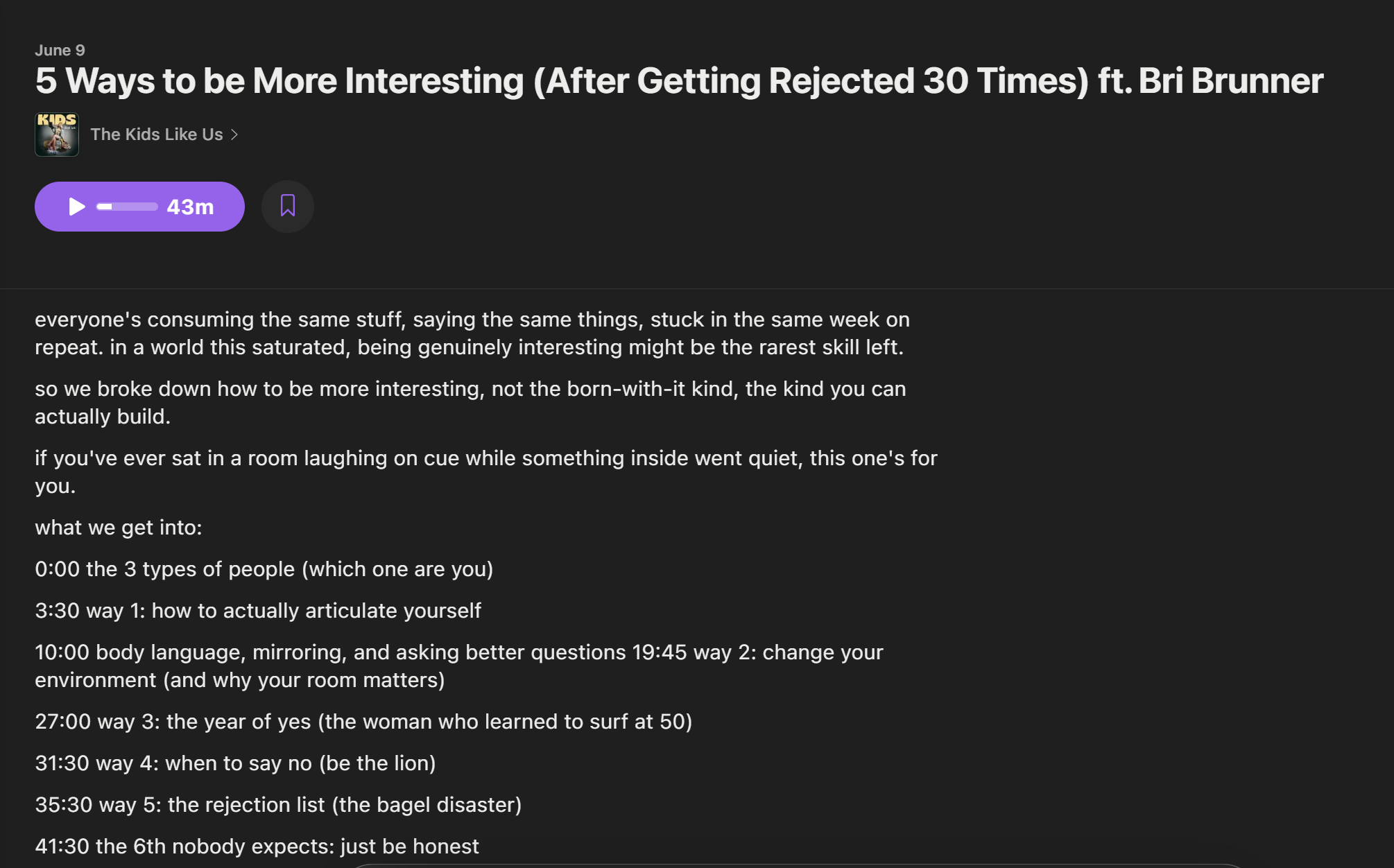
This was the premise of a podcast episode I recently recorded with Kids Like Us. I thought it would be cool to share my sparknotes.
When people think about becoming more interesting, they usually assume they need more exciting stories, more accomplishments, or a more adventurous life.
That's part of it.
But some of the most interesting people I've met aren't necessarily doing extraordinary things. They simply approach life differently. They communicate better, seek out new experiences, and put themselves in situations that create stories worth telling.
Here are five ways to do that.
1. Learn to Articulate Yourself Better
The people we find interesting don't always have the wildest stories. They just tell them better.
A mediocre story told well is often more memorable than an incredible story told poorly.
One of the easiest ways to improve your communication is to stop treating conversations like scripts and start treating them like prompts. With the rise of AI, I hope people will approach conversations more intentionally — especially after seeing how poor prompts return poor answers. The quality of the question often determines the quality of the answer.
We've been socially conditioned to ask and answer the same questions:
"What's new?" — "Not much."
Nothing kills a conversation faster.
Instead, ask better questions. Give better answers. Two of my favorite questions are what have you learned recently, and what was a highlight from this week?
A few practical ways to improve:
- Practice speaking out loud when you're alone. Talk through ideas while driving or walking.
- Eliminate filler words like "um," "like," and "so."
- Get comfortable with pauses. Silence often sounds more confident than rushing to fill space.
2. Say Yes More Often
Most people have a bias toward comfort.
The problem is that comfort rarely creates stories.
If you want experiences worth talking about, you have to put yourself in situations that are unfamiliar, inconvenient, and occasionally uncomfortable.
There will never be a perfect time to travel. There will never be a perfect time to start a new hobby. There will never be a perfect time to take a chance on something that excites you.
People often hide behind work, schedules, or responsibilities, but many of life's best experiences happen because someone decided to say yes before they felt ready.
3. Say No More Often
This sounds contradictory, but it's equally important.
Every no unlocks a higher value yes.
A calendar packed with obligations doesn't automatically mean you're making progress. Sometimes it just means you're busy.
Every meaningful pursuit requires protecting time and energy. The right "no" creates space for a better "yes."
If you're unsure which choice to make, ask yourself:
If you watched your life as a movie, what would you be screaming at the screen?
4. Change Your Environment
Behavior is often less about willpower and more about environment.
Most people try to change themselves without changing the conditions around them. That's backwards.
When I put a pull-up bar outside my bedroom, I went from being unable to do a single pull-up to eventually doing three. Not because I suddenly became more disciplined, but because I saw the bar multiple times every day.
The environment did part of the work for me.
If you want to learn the ukulele, leave it where you'll pick it up. If you want to dress better, plan your outfits the night before. If you want to read more, put a book on your nightstand and move your phone across the room.
The same principle applies to people. Your social environment influences what you consider normal.
If everyone around you complains, you'll complain more. If everyone around you is building businesses, creating art, traveling, learning, or taking risks, you'll start doing more of those things too.
You don't rise to your goals. You often sink to the standards of your environment.
Choose your surroundings carefully.
5. Try Rejection Therapy
One of the fastest ways to become more interesting is to become less afraid of rejection.
Jia Jiang became famous for documenting 100 days of rejection. Every day, he intentionally made unusual requests that had a high chance of being rejected. He asked to borrow $100 from a stranger, make his own sandwich at Subway, and get a haircut at PetSmart.
Not because he wanted to hear "no." Because he wanted to stop fearing it.
Over time, something interesting happened: many people said yes. And even when they didn't, he realized rejection wasn't nearly as painful as he imagined.
Most people spend their lives avoiding discomfort. They never ask.
Rejection therapy teaches you that the worst-case scenario is usually far less scary than the stories you tell yourself.
The goal isn't to get rejected. The goal is to become the kind of person who isn't controlled by the possibility of rejection.
Listen to the Full Episode
I go deeper on all five of these with Kids Like Us — including my own rejection therapy stories. Catch it wherever you listen: